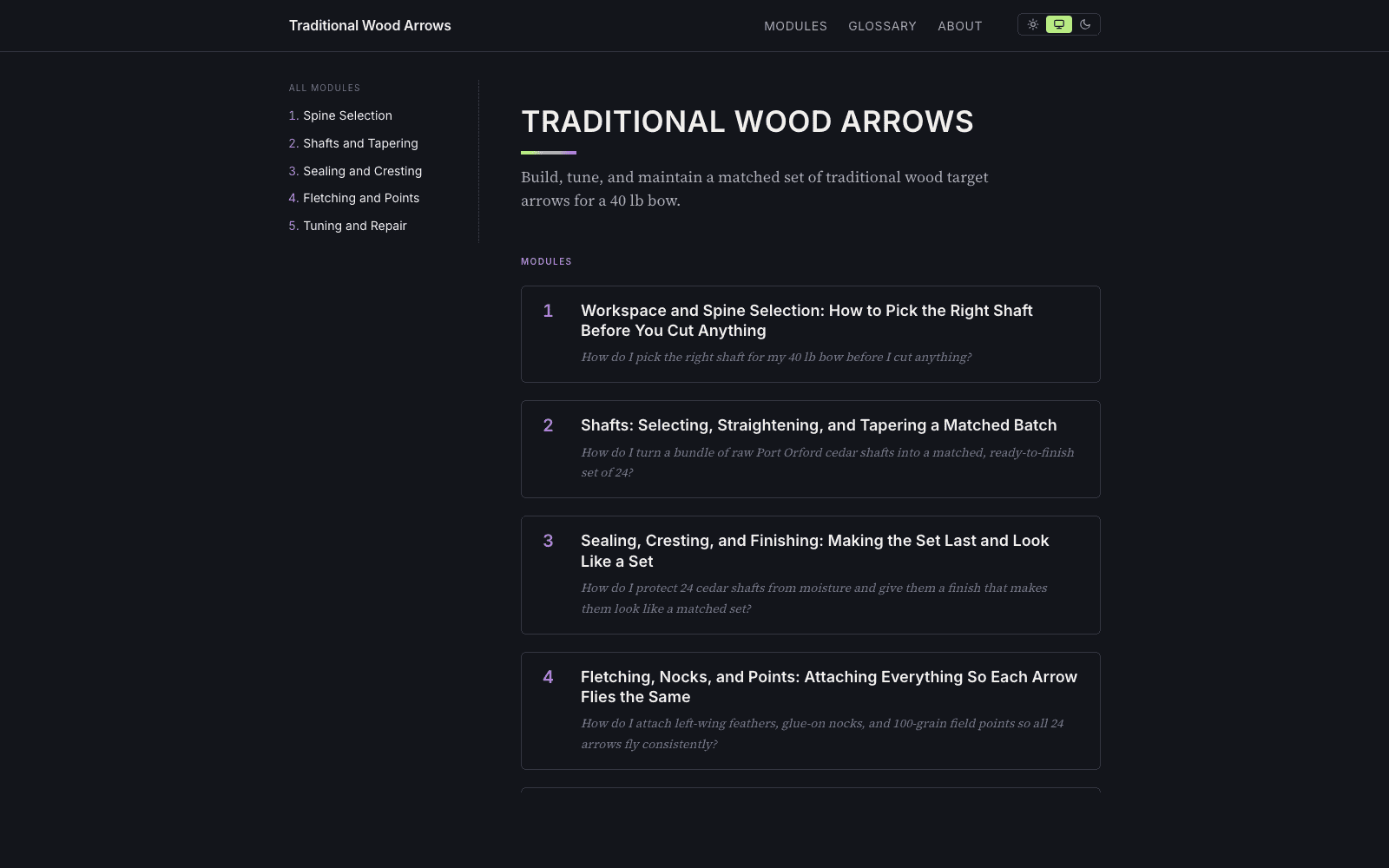
I learn best when I can poke at a focused, self-contained micro-site about whatever I’m trying to understand. So I built train-my-brain, a Claude Code plugin that does exactly that.
You run /tmb:create, it asks seven questions, then it spends about 30 minutes building the site—and that long session surprised me until I watched what it was actually doing.
Coming up with a sensible curriculum as a whole thing takes a lot of research, and then each module gets its own subagent doing more research in parallel before any prose gets written.
At the end you get a Hugo site running at localhost:1313. The screenshot above is one I built for making traditional wood arrows.
A few things I learned along the way:
- Research once, build in parallel. The first version had every module-builder agent do its own web research. They’d disagree on terminology and cite different sources. Now a single researcher writes
research.yamlfirst—glossary, reading list, concept map—and every parallel builder grounds its work in that one substrate. - Agents take the path of least resistance. Module-builders kept emitting
<!-- TODO: source image -->comments instead of actually finding free-use imagery. The TODO is invisible to readers; the page just looks like a wall of text. The fix was making real images or YouTube embeds a hard rule, not a preference. - Make the reviewer deterministic. Every check the consistency reviewer does is a small script under
scripts/—adjacency, frontmatter, URL reachability, glossary merge. If I let the LLM “review” something on its own, it would silently skip steps. A bash script that exits non-zero will not. - You can give Claude a real picker UI. The seven-question interview started as plain text prompts, which meant typo-prone free-text answers for things that should be multiple choice. Switching to the
AskUserQuestiontool gives you an actual TUI picker—arrow keys, enter to select—for any structured question. I had no idea that was available until I went looking. - Build a real one to find the real bugs. PR #1 was five fixes from building the arrow-building curriculum end to end. Quoting bugs in
new-module.sh, escaped Hugo shortcodes rendering as raw text, Mermaid v11 syntax gotchas. None of those showed up until I used the thing in anger.
The last step, if you want to share what you built with anyone else, is /tmb:publish—which walks you through pushing the site to GitHub Pages. That’s how the arrow-building sample above got online.
If you also like learning by building, give it a spin: claude plugin marketplace add alwaysmap/alwaysmap-marketplace && claude plugin install tmb@alwaysmap.