Situation #
A SaaS client was hiring across multiple Senior Software Engineer roles simultaneously. Inbound applications exceeded 1,000 candidates across open positions, and each one required a recruiter to download the resume, read it against the job description, and make a keep-or-reject decision.
At roughly five minutes per candidate, the manual review backlog was consuming the equivalent of a full-time recruiter. A quick audit suggested that 50–60% of applicants were clearly not qualified—wrong tech stack, wrong seniority, no relevant experience. The bottleneck wasn’t attracting candidates; it was processing them fast enough to reach the good ones before they accepted other offers.
Behavior #
This was part of a broader rethink of the client’s engineering hiring process. I created structured interview rubrics, trained interviewers on system design interviews, and set up a Talent Pool in BambooHR so warm candidates from previous rounds could be resurfaced for future roles.
The resume screening bottleneck was the most pressing piece: repetitive, criteria-based, and high-volume—ideal for AI augmentation rather than replacement. I built a tool that pulls applications and resumes from BambooHR, sends them to Claude for evaluation, and writes decisions with per-candidate reasoning back to each candidate record.
The system needed to be conservative—it was far worse to reject a potentially qualified candidate than to let a borderline one through to human review. I designed a three-tier decision framework (reject, manual review, approve to phone screen) and tuned the prompts so that ambiguous cases always route to a person. Role-specific dealbreakers are checked first, then application responses are validated, and only then does Claude evaluate the candidate against job requirements with a high evidence bar. Every decision must cite specific resume evidence, not generic impressions.
This was an interative process: fine-tune the system, talk through the sample results with the Head of HR, update the prompts. Then we were ready to work through 1K+ candidates.
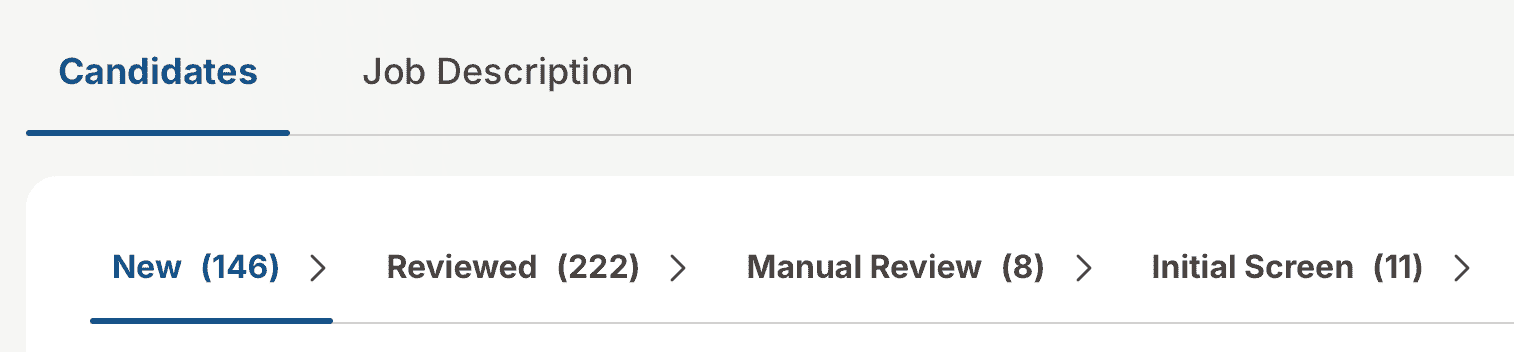
Reducing the size of the hiring funnel
Impact #
- 1,000+ candidates reduced to fewer than 300 requiring manual review. Recruiters focused on candidates who actually warranted human evaluation.
- 1–2% of candidates promoted directly to phone screen. The strongest matches surfaced immediately instead of sitting in a queue.
- ~60% auto-rejected with documented reasoning. Each rejection cited specific evidence, e.g., “.NET specialist with no Python experience despite claiming four years.”
- Review time per candidate dropped from ~5 minutes to seconds, with human review only needed for the ~38% with genuinely mixed signals.
- Caught patterns humans might miss at scale: suspected AI-generated profiles with formulaic metrics and implausible company names, credential mismatches where claimed skills had zero resume evidence, and future-dated employment raising credibility questions.
- Built-in audit trail. Every decision was logged with reasoning, enabling quality review and prompt iteration over time.