Situation #
Google was bringing a new API to market: Cloud Fleet Routing, which solves the vehicle routing problem. Give it a set of shipments, a fleet of vehicles, and a tangle of constraints—capacities, costs, time windows, driver breaks, traffic, mixed vehicle types—and it works out which vehicle takes which shipment in what order, for the lowest cost.
The request is deeply nested JSON and so is the response. Google wanted a reference application so customers could construct scenarios, tune constraint parameters, and visualize routes before writing any code.
I’d been building a cloud consulting practice at Woolpert since January 2019, with the consulting function set up to do billable engineering delivery. Woolpert was already a Google Maps reseller. This engagement was the first with Google itself as the client.
Behavior #
I wrote the proposal and won a $450K engagement to build the application from scratch. Delivery took six months with three of us on it: me as the TPM alongside two software engineers.
We worked with Google on a weekly cadence that was almost entirely async, so the project management had to be tight. I ran it Kanban-style rather than in fixed sprints, to accommodate an experiment-driven way of working where what we learned one week changed what was worth building the next.
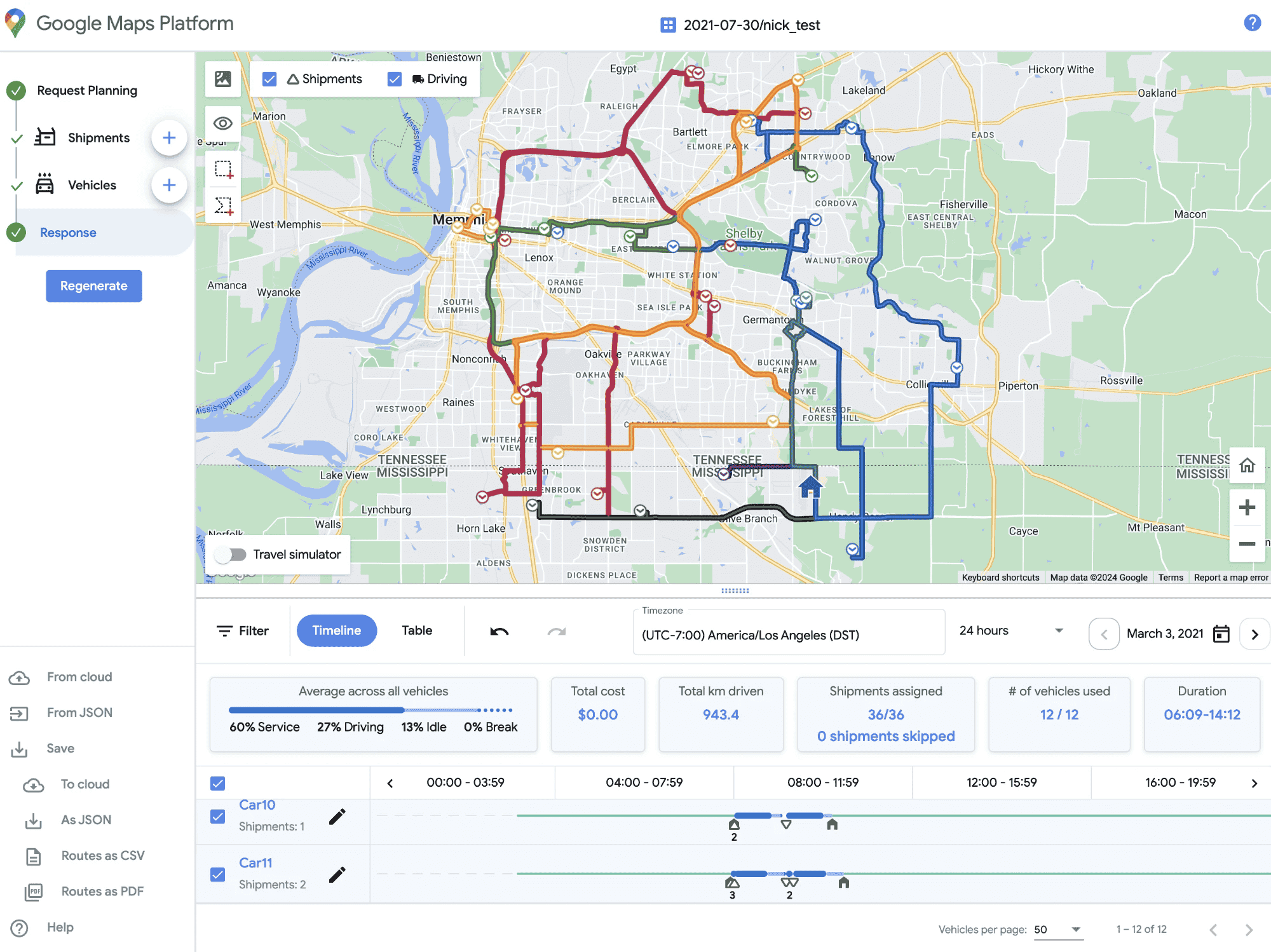
What we shipped, now open source as googlemaps/js-route-optimization-app, is a web application that walks a user through the API’s data model—request planning, then shipments, then vehicles—and returns the solved routes as a map, a per-vehicle timeline, and a table.
The screenshot at the top is one solved scenario: 36 shipments across 12 vehicles around Memphis.
It’s an Angular frontend on a Node backend, deployed into the customer’s own Google Cloud project with Terraform, and Woolpert’s demo write-up describes it as the dispatcher’s day-to-day interface for creating and “touching up” optimized solutions.
Impact #
- Google shipped it as the way to try the API. It’s how Google tells customers to explore Route Optimization: build a scenario, tune the constraints, and look at the routes before committing engineering time. Google’s demo and overview video walks through the app.
- Google named Woolpert in the GA announcement. Cloud Fleet Routing became the Route Optimization API and reached general availability on May 10, 2023. The post pointed customers at two partners for help deploying it: Accenture and Woolpert.
- First engagement with Google as the client, and a logo we could talk about. The practice had been building on Google’s platform for Woolpert’s customers; this one was delivered to Google, to Google’s standards. That made Google a publicly referenceable customer and a selling point with other prospective consulting clients.
- Still maintained years later. The app is Apache 2.0 licensed, and Google is still committing to it.